From the archive. The vendor landscape has changed since 2018; the selection criteria mostly haven't.
Customer Data Platforms inspire a lot of confusion. Best to begin with what they are and what they are not.
CDPs are:
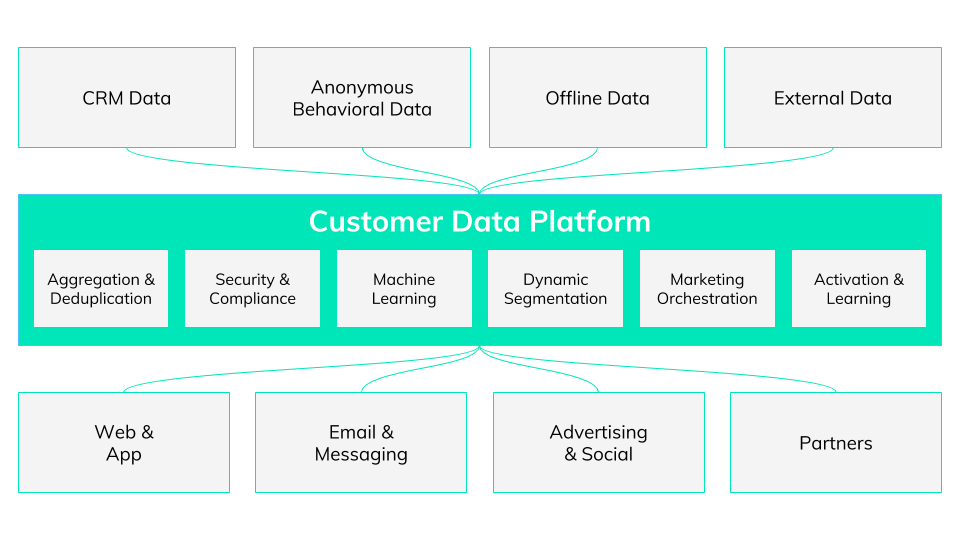
- A centralized platform for storing all of the user data about all of your users
- A platform non-technical employees can use to activate and act on user data
- A safe haven for secure user data management, compliant with current regulations and best practices
- A bridge to combine your user data with external data sets
- A rules engine for segment management. Want a cohort of users who opened an email and clicked a Facebook ad? No problem.
- A platform for collaboration that breaks down business-unit data silos
CDPs are not:
- CRM solutions built for sales or support teams to manage intricate customer workflows
- DMPs focused only on anonymous cookied users (though the gap is closing)
- Tag managers. Many CDPs began life as tag managers, and I think that history is a disadvantage. Just because you were a horse, it doesn't make you a better car.
Why integrate one? Centralizing user data, strengthening the intelligence around it, and democratizing access should move business goals across the board, from lower systems costs to better conversion rates.
Here are my Goldilocks ("just right") criteria for picking one:
Connectivity and I/O
A CDP is only as good as the pipes in and out of it. You want many roads in, from plug-and-play SDKs to full read/write APIs, plus pre-built connectors to the most popular data sources (CRM, ticketing) and activation endpoints (ad networks, social channels, email providers).
Security and compliance
User data security and governance is no easy task, and managing it internally is usually harder than outsourcing it well. You want a partner with a track record of secure data management, trusted comparable customers, no fear of security audits, and fast adaptation to changing regulation (GDPR being the obvious example). Internally, you want robust roles and permissions to partition sensitive data.
Administrative usability
CDPs exist to democratize data work for non-technical users, so demand a modern, usable UX for non-engineers. Some providers require light scripting for segment creation or activation. No good. Trial the admin experience with your least technical colleagues before signing.
Identity management and resolution
Your CDP should consolidate literally all available user data into a single profile, which may mean partnering with a device or identity-graph provider to stitch emails to cookies. It also means flexible storage limits. At Viacom, a certain percentage of the US population visits our sites or volunteers an email address, but our TV signals reach a much larger base. We need to pull all of it together without worrying about a vendor's storage costs or architectural limits.
Real-time segmentation updates
Profiles and segments should update in real time as users act, on and offline. Many CDPs update hourly, which is no bueno. If a user interacts with your site or an ad, their profile should update immediately so the next event in your funnel can fire. Many legacy-architecture vendors simply can't do this.
Integrated and automated machine learning
The best next-generation CDPs go beyond storage: they support unstructured data, use ML to create useful segments automatically, and even crawl and categorize your content to find patterns worth activating. They also support custom data science models, run inside the platform or through performant APIs. ML fanboy alert: this is one of my top considerations.
Smart orchestration
Your CDP should monitor funnel progress and add dynamic intelligence to usher users toward conversion. The alternative is intricate manual workflow management, hard to set up and harder to maintain. Done right, this enables truly personalized, omni-channel journeys that adapt to each user's profile and likelihood of converting.
Industry momentum
There's a ton of investment in the CDP space. Pick a horse with recent major funding from venture capital or a strategic investor. Many of these companies will not be in business in two years' time.